

PRODUCT DESIGN
INJURY
INTAKE
INJURY INTAKE
INJURY
INTAKE
CLAIMS
GEICO
CLAIMS GEICO
CLAIMS
GEICO
Year :
Year :
2026
2026
Industry :
Insurance/Claims
Client :
GEICO
Project Duration :
9 Months
Summary
Summary
I built the redesign of GEICO's Injury Intake experience, a high-stress claims flow used by customers reporting injuries after an accident. The goal was to reduce friction in a complex self-reporting journey, improve confidence during claim submission, and create a clearer path for customers in a vulnerable moment.
This work combined UX strategy, prototyping, user research, and cross-functional collaboration to improve both the customer experience and internal team alignment.
The Challenge
The Challenge
The original injury intake flow relied on a one-question-per-page structure, requiring customers to navigate detailed, often complex injury questions at a moment of high stress and uncertainty. This led to a significant drop-off, with many users abandoning the process and defaulting to calling an adjuster.
The original injury intake flow relied on a one-question-per-page structure, requiring customers to navigate detailed, often complex injury questions at a moment of high stress and uncertainty. This led to a significant drop-off, with many users abandoning the process and defaulting to calling an adjuster.
Prototype Testing
The redesign increased completion and throughput from 16,000 to 56,000+ customers. Prototype testing with users who had experienced mild to severe injuries revealed three critical gaps:
The flow did not align with the user’s emotional and cognitive state immediately after an accident
Users lacked reassurance that they were completing the process correctly
Users needed a clearer way to review, confirm, and retain what they had submitted
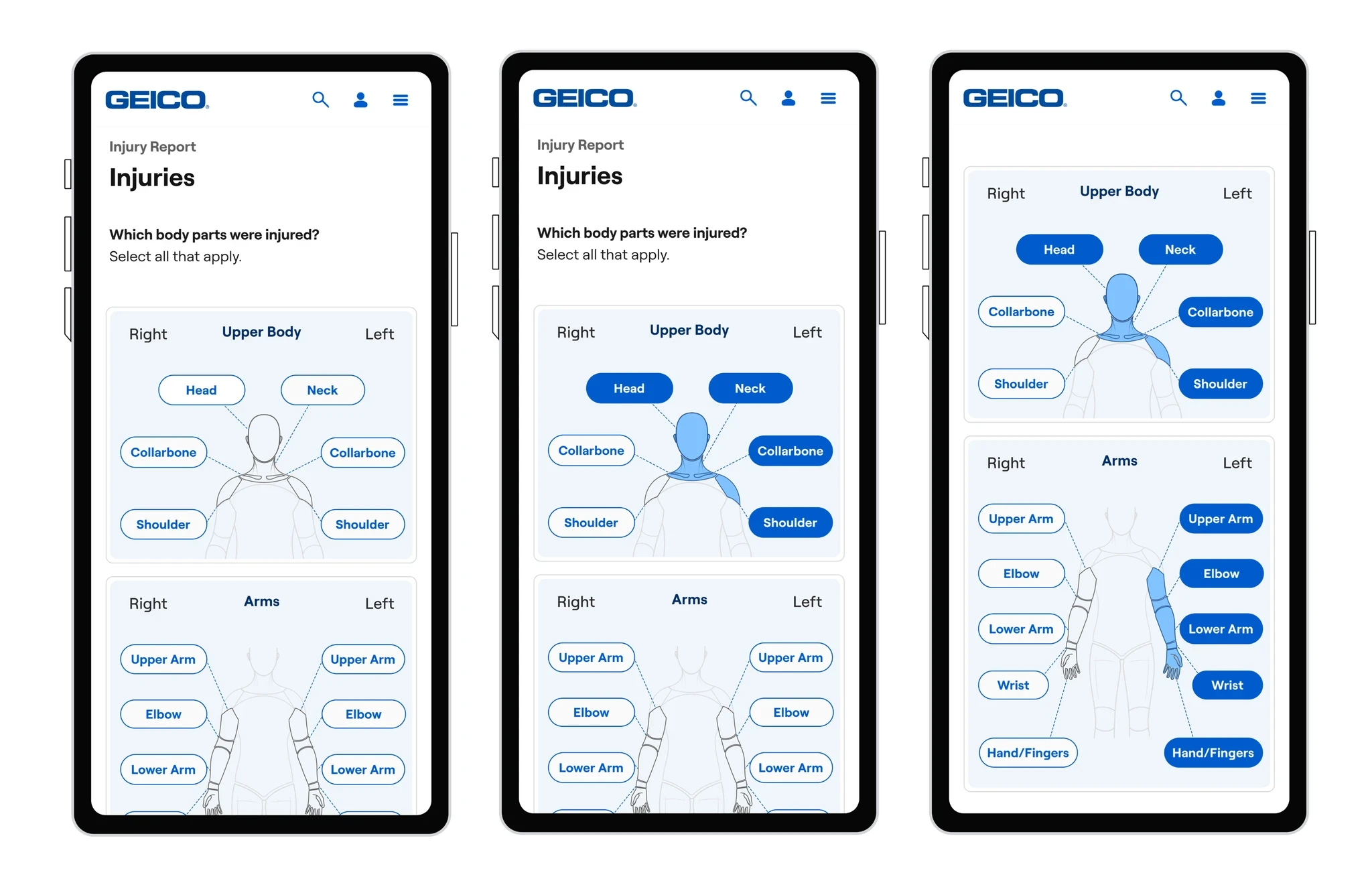
The redesigned Injury Intake experience significantly improved customer engagement and claim completion during one of the most stressful moments in the claims journey. Through user research, rapid prototyping, and iterative usability testing, the experience became more intuitive, reassuring, and aligned with customers' emotional state following an accident.
The redesigned Injury Intake experience significantly improved customer engagement and claim completion during one of the most stressful moments in the claims journey. Through user research, rapid prototyping, and iterative usability testing, the experience became more intuitive, reassuring, and aligned with customers' emotional state following an accident.
The redesigned Injury Intake experience significantly improved customer engagement and claim completion during one of the most stressful moments in the claims journey. Through user research, rapid prototyping, and iterative usability testing, the experience became more intuitive, reassuring, and aligned with customers' emotional state following an accident.
Reduced abandonment and improved customer confidence through clearer progress indicators, review screens, and confirmation mechanisms.
Contributed to the filing of Patent Application P10092, helping establish one of GEICO's first AI-assisted injury intake experiences.
Rapid prototyping, and iterative usability testing, the experience became more intuitive, reassuring, and aligned with customers' emotional state following an accident.
Rapid prototyping, and iterative usability testing, the experience became more intuitive, reassuring, and aligned with customers' emotional state following an accident.
Rapid prototyping, and iterative usability testing, the experience became more intuitive, reassuring, and aligned with customers' emotional state following an accident.
Reduced abandonment and improved customer confidence through clearer progress indicators, review screens, and confirmation mechanisms.
Contributed to the filing of Patent Application P10092, helping establish one of GEICO's first AI-assisted injury intake experiences.
Featured WorK
PRODUCT DESIGN
INJURY
INTAKE
INJURY INTAKE
INJURY
INTAKE
CLAIMS
GEICO
CLAIMS GEICO
CLAIMS
GEICO
Year :
Year :
2026
2026
Industry :
Insurance/Claims
Client :
GEICO
Project Duration :
9 Months
Summary
Summary
I built the redesign of GEICO's Injury Intake experience, a high-stress claims flow used by customers reporting injuries after an accident. The goal was to reduce friction in a complex self-reporting journey, improve confidence during claim submission, and create a clearer path for customers in a vulnerable moment.
This work combined UX strategy, prototyping, user research, and cross-functional collaboration to improve both the customer experience and internal team alignment.
The Challenge
The Challenge
The original injury intake flow relied on a one-question-per-page structure, requiring customers to navigate detailed, often complex injury questions at a moment of high stress and uncertainty. This led to a significant drop-off, with many users abandoning the process and defaulting to calling an adjuster.
The original injury intake flow relied on a one-question-per-page structure, requiring customers to navigate detailed, often complex injury questions at a moment of high stress and uncertainty. This led to a significant drop-off, with many users abandoning the process and defaulting to calling an adjuster.
Prototype Testing
The redesign increased completion and throughput from 16,000 to 56,000+ customers. Prototype testing with users who had experienced mild to severe injuries revealed three critical gaps:
The flow did not align with the user’s emotional and cognitive state immediately after an accident
Users lacked reassurance that they were completing the process correctly
Users needed a clearer way to review, confirm, and retain what they had submitted
Prototype Testing
The redesign increased completion and throughput from 16,000 to 56,000+ customers. Prototype testing with users who had experienced mild to severe injuries revealed three critical gaps:
The flow did not align with the user’s emotional and cognitive state immediately after an accident
Users lacked reassurance that they were completing the process correctly
Users needed a clearer way to review, confirm, and retain what they had submitted
The redesigned Injury Intake experience significantly improved customer engagement and claim completion during one of the most stressful moments in the claims journey. Through user research, rapid prototyping, and iterative usability testing, the experience became more intuitive, reassuring, and aligned with customers' emotional state following an accident.
The redesigned Injury Intake experience significantly improved customer engagement and claim completion during one of the most stressful moments in the claims journey. Through user research, rapid prototyping, and iterative usability testing, the experience became more intuitive, reassuring, and aligned with customers' emotional state following an accident.
The redesigned Injury Intake experience significantly improved customer engagement and claim completion during one of the most stressful moments in the claims journey. Through user research, rapid prototyping, and iterative usability testing, the experience became more intuitive, reassuring, and aligned with customers' emotional state following an accident.
Reduced abandonment and improved customer confidence through clearer progress indicators, review screens, and confirmation mechanisms.
Contributed to the filing of Patent Application P10092, helping establish one of GEICO's first AI-assisted injury intake experiences.
Rapid prototyping, and iterative usability testing, the experience became more intuitive, reassuring, and aligned with customers' emotional state following an accident.
Rapid prototyping, and iterative usability testing, the experience became more intuitive, reassuring, and aligned with customers' emotional state following an accident.
Rapid prototyping, and iterative usability testing, the experience became more intuitive, reassuring, and aligned with customers' emotional state following an accident.
Reduced abandonment and improved customer confidence through clearer progress indicators, review screens, and confirmation mechanisms.
Contributed to the filing of Patent Application P10092, helping establish one of GEICO's first AI-assisted injury intake experiences.